
On October 16th, 1859, abolitionist John Brown led a group of followers in an armed attack on the U.S. Armory and Arsenal at Harper’s Ferry, Virginia (now West Virginia). Brown had hoped the attack would spark a slave revolt across the South, or at least cause many slaves to join him at Harper’s Ferry. But it seemed nothing went as Brown had planned. By the morning of the third day, October 18th, U.S. Marines under LT Israel Greene (overall commander of Federal forces opposing Brown was Brevet Colonel Robert E. Lee, the future Confederate general) stormed the engine house where Brown and the last of his men had fortified themselves. Of the 22 raiders, 10 were killed during the raid, 7 were captured and later hanged, and 5 managed to escape. Brown himself was badly wounded but survived to stand trial. Brown was tried in Virginia state court rather than a Federal court largely due to the intervention of Governor Henry Wise and the ease with which he convinced President James Buchanan. Brown was convicted after the jury deliberated for less than an hour. On November 2nd, 1859, after Brown gave a statement that became known as his “last speech,” he was sentenced to death by hanging. Due to Virginia law a month had to pass before the sentence could be carried out. In the intervening time, plans for a rescue were made by some abolitionists, including Thomas Wentworth Higginson, but none were carried out. That month Brown had hundreds of visitors, wrote over 100 letters (most of which were immediately published), and hundreds of letters were received by Brown, Governor Wise, and others connected to the trial. Brown’s trial was the first to be reported in newspapers around the entire country (even the West Coast) due to the recent completion of the transcontinental telegraph. Although newspapers everywhere reported on the event, only a few papers actually had reporters present, and at least one of those reporters went to great lengths to hide his identity from locals. Brown was hanged on December 2, 1859, the first person to ever be executed for treason in the United States. His funeral would take place on December 8, 1859, after his wife Mary had traveled with Thomas Wentworth Higginson and others to retrieve the body from Virginia and bring it home to North Elba, New York.
Kelly and I took a trip to northern New York in late November 2024 and had the opportunity to visit the Brown farm and see his grave. Note the snow already on the ground in November.
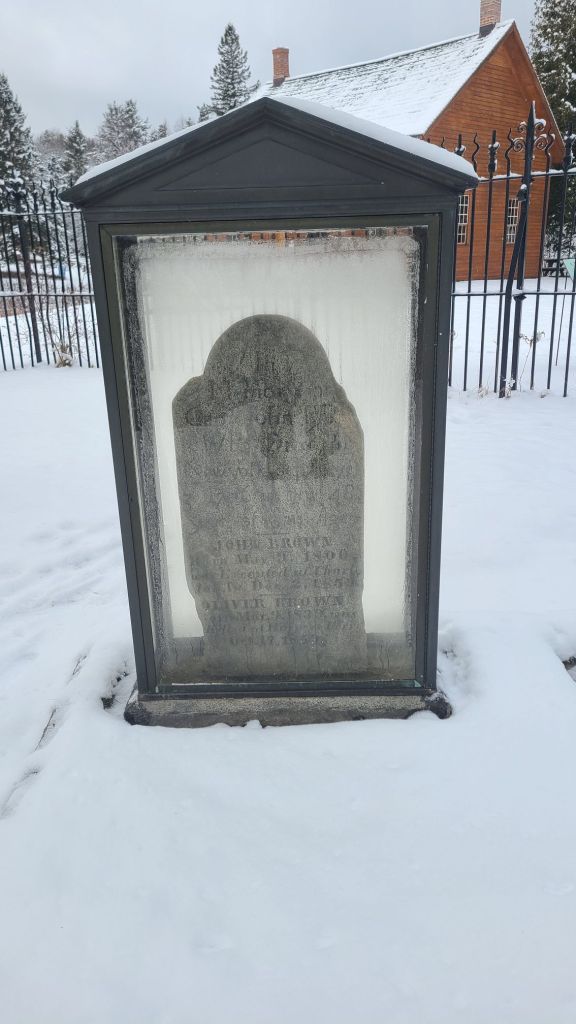
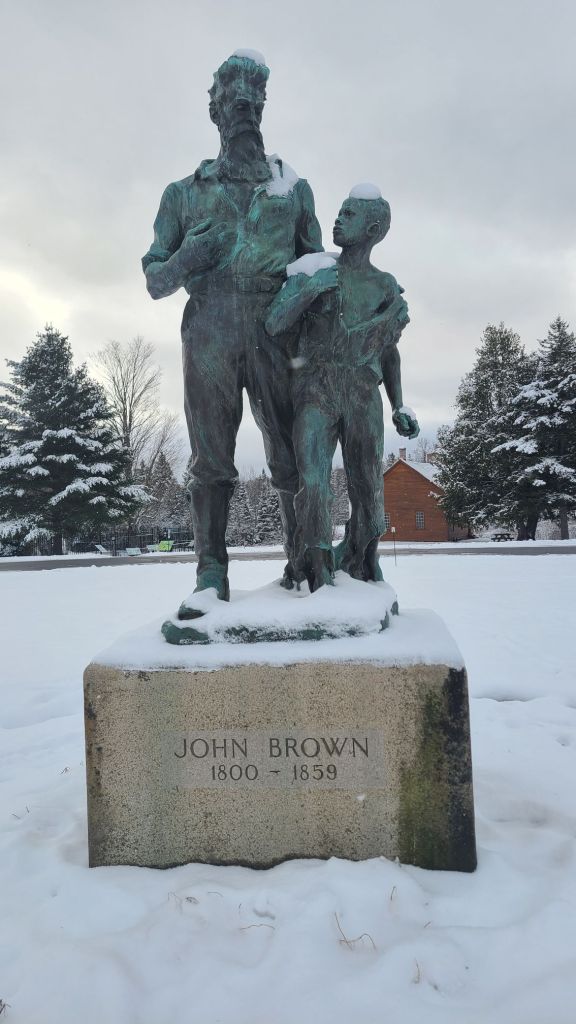
As I get back into the habit of posting here in our blog, I will put up more pictures from our little day trips like this.
– Geoff

