Some thoughts on Russia and Ukraine (i.e. How We Got Here)

Although in college I majored in history, with a focus on 19th century American history, my minor was political science with a focus on the Soviet Union and Russia. So I studied Russian history and culture, took three semesters of Russian language and one of Russian literature, and a variety of courses about the collapse of the Soviet Union, the political reshaping of Eastern Europe (including the conflicts in the former Yugoslavia), and post-Communism Russia. It’s a fascinating country, and has loomed large in the history of Europe, particularly its neighbors in Eastern Europe, like Ukraine. I have admired Russian writers, adored Russian composers, and occasionally tried some Russian food, although frankly I liked the food much less than other aspects of Russian culture. Making Russian friends also gave me the chance to practice my Russian language skills, and my mastery of Russian profanity and idioms made some of my Russian friends laugh and at least one stop in her tracks and say “Where did you learn THAT?” My background in Russian also came in handy a bit when I worked in the defense industry. But after I left the industry in 2009, I just didn’t really get the chance to do much with all that knowledge anymore.

Then in 2013, something happened in Ukraine. The Ukrainian parliament had voted overwhelmingly in favor of an agreement with the European Union that the President of Ukraine (Viktor Yanukovych) then refused to sign, apparently due to influence from Russia. Protests began in Independence Square in Kyiv that quickly grew massive as Ukrainians wanting closer relations with Europe began demanding the resignation of not only President Yanukovych but the entire Azarov government as well. The protests which began in November 2013 became known as Yevromaidan (or more commonly in English, Euromaidan) after a Twitter account appeared with that name and quickly gained popularity. Euromaidan soon became the largest pro-democracy movement in Europe since 1989. Protestors were particularly angry with Yanukovych’s blatant corruption, official malfeasance, and especially human rights violations, which was further emphasized by his crackdown on protesters beginning on November 30th, resulting in dozens of people injured (including several journalists) after numerous excessive force incidents by the Berkut riot police. The response by the public was overwhelmingly in support of the protesters, and more than 500,000 Kyivans (some estimates went as high as 800,000) joined them in the streets. Violence continued to escalate the following day and then on December 11 a government force of about 4,000 Berkut, VV internal troops, and government-paid street thugs (known as Titushky) attacked the protester camp just after 1 AM with the intent to clear it out. People were summoned to the square by the ringing of the bells of St. Michael’s Golden-Domed Monastery continuously for four hours. Ultimately the protesters prevailed and pushed the government forces completely out of the square.

The government responded by passing severe laws against public protests. This precipitated violent clashes between protesters and police on Hrushevsky Street not far from Independence Square between January 19 and January 22nd, 2014. This led to the occupation of government buildings by protesters all over Ukraine. The anti-protest laws were repealed (mostly) and Prime Minister Mykola Azarov resigned on January 28th. This, plus an amnesty issued to protesters on February 16th, calmed tensions down briefly before violence again broke out on February 18th. The worst violence was on February 20th, when the outbreak of protests that became known as the Revolution of Dignity led to the deaths of nearly 100 protesters and 13 police officers. Most of the protester deaths were from rooftop police snipers, who began firing on the protesters as they advanced. The following day an agreement was signed between Yanukovych and his political opposition that organized an interim government and created reforms such as changes in the constitution and new elections. Despite signing the agreement, and despite the fact that he would have remained president (with some of his powers limited), Yanukovych fled Kyiv in secret that evening. The next day the Ukrainian parliament voted unanimously to remove Yanukovych since he had abandoned his official duties and also voted to reinstate the 2004 constitution.

Yanukovych had fled to Russia, where he had a press conference on February 28th. He declared the planned elections in Ukraine “illegal.” In turn, Russian President Vladimir Putin declared what happened in Ukraine a “coup” while at the same time ordering the Russian military to make plans to seize Crimea. Beginning on February 27, 2014 Russian spetznaz (they had removed all Russian insignia but weren’t fooling anyone) seized control of most of the Ukrainian military bases in Crimea, the Simferopol Airport, and government buildings in Crimea. Putin and Russian media pretended that these “mysterious” troops were locals who had “spontaneously” risen up and uniformed and equipped themselves from military surplus stores and the Ukrainian military. But of course, it was utter bullshit – they were Russian troops seizing Ukrainian territory. Russia’s bald-faced seizure of Crimea was followed by a “referendum” on March 16, 2014 in which local voters were given two choices, neither of which was to remain Ukrainian. The campaign before the election was in essence pro-Russian, with posters accusing the new Ukrainian government of being fascists and Neo-Nazis and featuring crossed-out swastikas. Ironically, the Russians invited election observers from Europe who were entirely from European far-right political parties and groups, some of which were almost certainly actual neo-Nazis. Unsurprisingly, the observers said everything was fine with the referendum, with between 95 and 98% of votes cast in favor of becoming part of Russia. This was the first time a European country had annexed another European country’s territory since World War Two. At the same time that Russia took Crimea, protests that were pro-Russian and anti-Maidan began in parts of southern and eastern Ukraine, the parts of Ukraine where ethnic Russians were concentrated and Russian was more commonly spoken. In the eastern Donbas, this became an active conflict between pro-Russian separatists and the new Ukrainian government. Again, the Russians secretly fed the conflict with men and materiel. By August, 2014 Ukraine had regained much of its territory, which in turn led the Russians to step up their military intervention and help the pro-Russian forces take back most of the lost territory.

An agreement was signed in Minsk in September 2014 that implemented a cease-fire and was supposed to lead to elections in December. But the separatists preempted this with their own elections in November, which of course the Russians embraced, in defiance of the Minsk agreement they had signed. In January 2015 the Russians sent another sizable military force into the war to help the separatists and Ukraine lost control of Donetsk and Debaltseve by the end of the month. So in February a second attempt at peace was made in Minsk with the participation of Belarus, Russia, Germany, France, and Ukraine. Ukraine was struggling. Russia was pouring weapons and soldiers into the area while still pretending that they weren’t, even arguing that they couldn’t help with the implementation of the new Minsk agreement because they weren’t really involved in the war. This absurdity was further complicated by repeated violations of the ceasefire and also by the arguments between the combatants over local elections in the two Ukrainian Oblasts where the separatists were concentrated: Donetsk and Luhansk. After being postponed from the fall of 2015 to the spring of 2016, the elections were postponed to July and then postponed again to November 2016.

This mess continued, more or less, until 2019 when a new agreement was signed by the Organization for Security and Cooperation in Europe (OSCE), Ukraine, Russia, and the Russian-controlled oblasts of Donetsk and Luhansk with their weird Russian-controlled-but-pretending-not-to-be governments. I am not going to try to coherently explain that whole period because frankly, it’s a huge mess. I don’t understand everything, and I have studied it closely. By this time Volodymyr Zelenskyy had been elected President of Ukraine, and his whole story (though fascinating) is beyond the scope of this post. But just know that Zelenskyy tried in good faith (I believe) to end the war in Donbas through the Minsk agreements and probably still thought he could have talks with Putin and achieve peace as late as 2021 or possibly early 2022. But Putin has never, ever, ever, in my opinion, negotiated in good faith. Even after massive troops buildups near the Ukrainian border, Russian officials kept insisting that Russia did not have plans to invade Ukraine as late as February 23, 2022. And so naturally they invaded Ukraine on February 24, 2022.

That brings us up to the war as it currently taking place. It is the largest and bloodiest (by far) war in Europe since World War Two. And the reason it is happening at all is entirely due to Vladimir Putin and Russia. Russia seems to have thought it would be able to capture Kyiv within a few days, and basically control the country within less than two weeks. Putin’s speech he gave on Russian media at the start of the invasion was full of all sorts of ridiculous and totally baseless claims: Russian troops were “peacekeepers” coming in to save the people of Donetsk and Luhansk from Ukrainian “neo-Nazis” that were controlled by the West. He also claimed that Ukraine was committing genocide against ethnic Russians, that Ukraine was trying to build nuclear weapons, and that they were allowing NATO to build secret bases on their territory or some shit. He also claimed Russia just wanted the “demilitarization and deNazification” of Ukraine. The amount of horseshit that is flowing out of Russia concerning Ukraine and the war is enough to fertilize the Sahara Desert. People pushing the Russian talking points CANNOT BE TRUSTED. Sadly, that includes a lot of westerners, including Americans from both the far-right and far-left of the political spectrum. If you think that they aren’t doing it for the money (and I am willing to bet a lot of them are in fact being paid by Russia), you are probably wrong.

I still love much about Russian history and culture. But Russia is led by one of the most awful people on the planet, and nothing and no one will convince me otherwise, ever. The day he is gone will be a joyous day for humanity, kind of like a certain orange person we all know and hate.

So, anyway. Whew. That was a lot of work. Hopefully a good summary. My apologies for the preponderance of Wikipedia links, but since most media is now stuck behind paywalls, my options are much more limited.

-Geoff
Today in History – John Brown Leads Raid on Harper’s Ferry

On October 16th, 1859, abolitionist John Brown led a group of followers in an armed attack on the U.S. Armory and Arsenal at Harper’s Ferry, Virginia (now West Virginia). Brown had hoped the attack would spark a slave revolt across the South, or at least cause many slaves to join him at Harper’s Ferry. But it seemed nothing went as Brown had planned. By the morning of the third day, October 18th, U.S. Marines under LT Israel Greene (overall commander of Federal forces opposing Brown was Brevet Colonel Robert E. Lee, the future Confederate general) stormed the engine house where Brown and the last of his men had fortified themselves. Of the 22 raiders, 10 were killed during the raid, 7 were captured and later hanged, and 5 managed to escape. Brown himself was badly wounded but survived to stand trial. Brown was tried in Virginia state court rather than a Federal court largely due to the intervention of Governor Henry Wise and the ease with which he convinced President James Buchanan. Brown was convicted after the jury deliberated for less than an hour. On November 2nd, 1859, after Brown gave a statement that became known as his “last speech,” he was sentenced to death by hanging. Due to Virginia law a month had to pass before the sentence could be carried out. In the intervening time, plans for a rescue were made by some abolitionists, including Thomas Wentworth Higginson, but none were carried out. That month Brown had hundreds of visitors, wrote over 100 letters (most of which were immediately published), and hundreds of letters were received by Brown, Governor Wise, and others connected to the trial. Brown’s trial was the first to be reported in newspapers around the entire country (even the West Coast) due to the recent completion of the transcontinental telegraph. Although newspapers everywhere reported on the event, only a few papers actually had reporters present, and at least one of those reporters went to great lengths to hide his identity from locals. Brown was hanged on December 2, 1859, the first person to ever be executed for treason in the United States. His funeral would take place on December 8, 1859, after his wife Mary had traveled with Thomas Wentworth Higginson and others to retrieve the body from Virginia and bring it home to North Elba, New York.

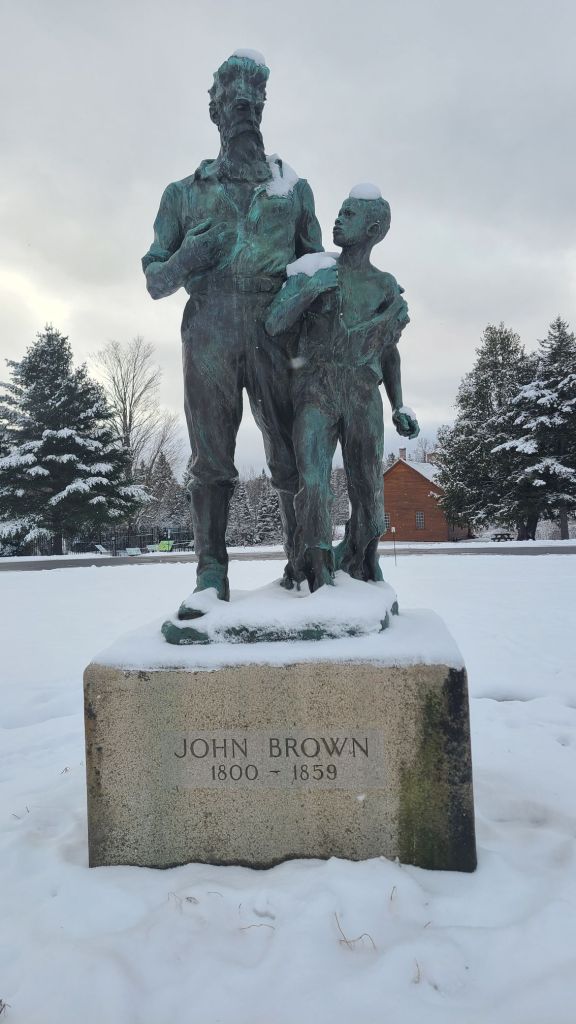
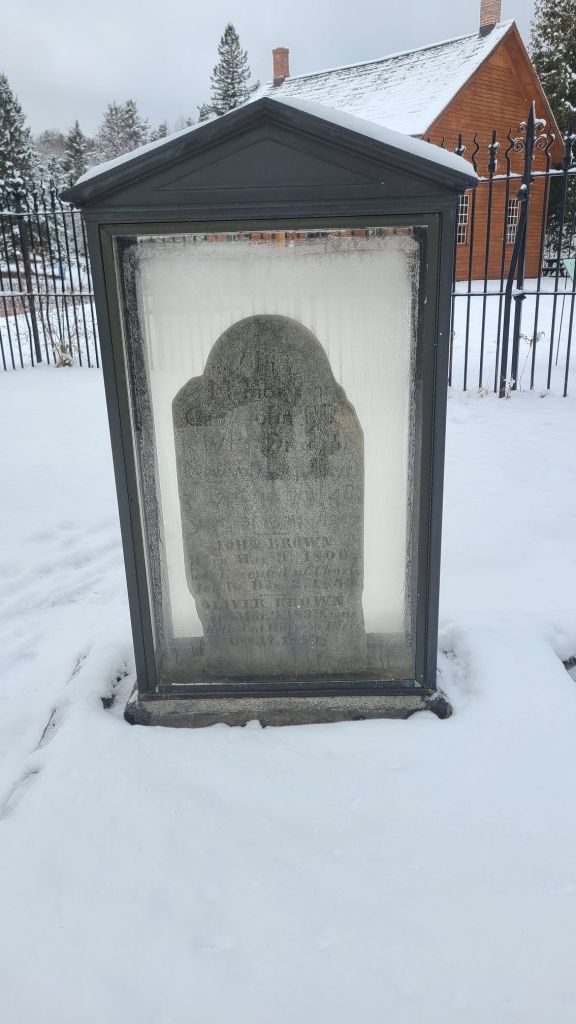
Kelly and I took a trip to northern New York in late November 2024 and had the opportunity to visit the Brown farm and see his grave. Note the snow already on the ground in November.

The grave, using the headstone Brown brought from Connecticut that had previously belonged to his grandfather who died in 1776. After that grave got a new headstone, Brown brought the old one to his New York farm.
Statue of Brown by Joseph Pollia that was erected in 1935.

As I get back into the habit of posting here in our blog, I will put up more pictures from our little day trips like this.

– Geoff

Second Class

Today the United States made approximately 52% of the population second class citizens. In doing so, it removed any doubt as to whether or not the US is a first world nation. Any nation that is so corrupt as to allow the system designed to keep different branches of the government both separate and in check to rot away completely is a failed state.

Overturning Roe isn’t just about the overweening hatred of women and pregnant people that is foundational to the Republican/Fundamentalist/Catholic/White Supremacist/Billionaire/Toxic Cis Hetero-normative hegemony in this nation. It’s about fear and control. It is not and has never been about the unborn. If it was, prenatal care would be both funded and required, and people who neglected pregnant people’s healthcare would actually suffer consequences. But they don’t.

There is no pro in the “pro-life” movement. The anti-choice movement was created as a political movement to unite historically opposed allies so Republicans could get elected. That’s it. That’s the “pro-life” movement. It’s a con, and a very successful one.

If you think you’re virtuous because you’re screaming at people going in and out of Planned Parenthood, the vast majority of whom are receiving basic medical care regardless of sex or gender, you’re just being a judgmental asshole. If you think it’s acceptable to tell people that “women just shouldn’t be able to kill babies” then you don’t understand science, and you’re still an asshole. If you think someone who has been raped should be required to carry their rapist’s potential offspring to term, you’re certainly not getting your advice on morality from Jesus, and you’re an asshole.

The truth is, abortion is not mentioned in the Christian Bible. Other faiths, such as Judaism and Islam, actually value the lives of their adherents and consider abortion to be necessary medical care to save the lives of the already born. You know, those of us in whom society has already invested. In other words, the lives of actual people.

But here in the United States a small group of very wealthy, very white nominally Christian people have hoodwinked many of you and outright fucked the rest of us. They play on your fears. They turn your basest instincts about in-groups, out-groups, skin color, and sex, into weapons and then use them against you. Really, to a large extent this isn’t even about Democrats or Republicans, this is about Oligarchs. Because at the end of the day, if you have a uterus and you’re rich, you’ll be able to get necessary medical care, like an abortion, no matter what.

It’s the ordinary people, the rest of us, that will suffer, as we do now. We suffer in a failed nation with no nationalized health care; institutionalized racism and sexism; homophobia and transphobia; ableism and systemic and cultural indifference to the disabled; and with a huge part of the population that genuinely believes that it is really OK to hate loudly and proudly. We suffer with the largest incarcerated population in the “civilized” world, and we have an epidemic of gun violence unlike any other country on earth.

Roe is the first, but it won’t be the last. While we’re all angry now, let us make today important not because of what we lost, but because of what we begin. Let today be the day that historians recognize as the beginning of the revolution. Oligarchs, we are coming for you. Everyone else needs to get on the correct side of history, or else fall with the Oligarchs. They are going to wish we only had torches and pitchforks.

Our Holiday Card, and by the way, GOOD RIDDANCE to 2020

Well everyone, today is the last day of 2020, and I have to say Thank GOD it is finally coming to a close.  This has been a tough year for virtually everyone*, and for some people it has been just horrific.  Kelly and I have managed to make it through the year without getting COVID (at least as far as we know) and we are both still employed**.  But we did lose one of our beloved fur-kids – our little Thumbelina: the princess; the Khaleesi; the mighty little Emperox of our universe.  We miss her and still often think about her.  

2020 melting onto a dumpster with a fire raging in the foreground. There is a night sky in the background with COVID virus particles falling like snow, one of which is on the moon.
See the blazing dump before us fa la la la la, la la la la.

Continue reading “Our Holiday Card, and by the way, GOOD RIDDANCE to 2020”

Today in Civil War History

On this day, December 1st, in 1864, a weary column of Federal troops arrived in Nashville, Tennessee, having marched directly from the battlefield of Franklin. In that short but fierce battle, Union troops fighting behind fortifications had succeeded in repulsing several attacks by Confederate troops the previous day, November 30th. Casualties were lopsided: 189 Union dead and just over 1,000 wounded versus some 1,750 dead and at least 3,800 wounded Confederates.

The spectacularly grand but fruitless charges had annihilated much of the experienced leadership of the Confederate Army of Tennessee. The rebels lost 14 generals that day: five killed outright, one mortally wounded, seven wounded, and one captured. Somewhere around 55 regimental commanders were killed, wounded or captured as well. By the evening of November 30th/December 1st, there were Confederate regiments commanded by sergeants and brigades commanded by captains.

Much of the battlefield has been developed, sadly, but in recent years more and more of the site has been recovered and returned to what it looked like at the time of the battle. Years ago I did some living history programs at the Carter House there in Franklin.

For more in-depth information, try this book: The Confederacy’s Last Hurrah; Spring Hill, Franklin, and Nashville by Wiley Sword.

Geoff

Today in History – the PTBT. Plus commentary on current events.

Today, October 7th, is the 57th anniversary of President John F. Kennedy signing the Partial Test Ban Treaty, officially known as the Treaty Banning Nuclear Weapon Tests in the Atmosphere, in Outer Space, and Under Water.

Considering how dangerously close we had gotten to World War III during the Cuban Missile Crisis the previous October, this treaty was a long step towards a permanent solution to the dangers of nuclear war. I am old enough to remember the last few times we really had to worry about nuclear war, like back in 1983. That was the year the TV movie “The Day After” came out, and also happened to be the year we had a couple of close calls of which the American public was blissfully unaware.

One of our more interesting Brimfield finds. Although you can find similar Fallout Shelter signs online for sale, I have not seen any others that include the “Capacity” markings.

Continue reading “Today in History – the PTBT. Plus commentary on current events.”

Today in History: The Great New England Hurricane of 1938

Today is the 82nd anniversary of the day the “Long Island Express” came ashore on Long Island, New York.  This is the storm that my grandparents’ generation always talked about when they talked about how bad hurricanes in New England could get.

Pretty damn bad.

Continue reading “Today in History: The Great New England Hurricane of 1938”

The Battle of Fredericksburg as my ancestor saw it

The Battle of Fredericksburg was fought from December 11th to December 15th, 1862.  Among the 120,000 or so Union soldiers in the Army of the Potomac was a 36 year old French-Canadian immigrant named Moises Beaulieu.  Moises had enlisted in June 1861 in Company A of the 11th Massachusetts Volunteer Infantry Regiment (sometimes known as the Boston Volunteers) and thus had already been in the Union army for some 18 months when he found himself on the bank of the Rappahannock River across from the town of Fredericksburg, Virginia.  Major General Ambrose Burnside, a Rhode Islander who had risen from Colonel of the 1st Rhode Island to commander of the army, was waiting for pontoons to arrive so bridges could be built across the river. At that time the 11th Massachusetts was in Brigadier General Joseph Carr’s brigade, of Brigadier General Dan Sickles’ Second Division of George Stoneman’s Third Corps, part of the Center Grand Division commanded by Major General Joseph Hooker.

Continue reading “The Battle of Fredericksburg as my ancestor saw it”

An obscure anniversary and an obscure Union general

Today is the anniversary of the Battle of Corinth (distinguished from the Siege of Corinth) that took place on October 3rd and 4th, 1862.  Union forces under the command of Major General William Starke Rosecrans defeated Confederate forces under the command of Major General Earl Van Dorn.

These days Rosecrans, if he is remembered at all, is known for being the Union commander at the gigantic Battle of Chickamauga in September 1863, one of the major Union defeats of the war and the second-bloodiest battle of the entire war after Gettysburg.  But up to that point he had actually been one of the most successful Union generals Lincoln had.  I learned a great deal about him during my time at Stones River National Battlefield, where Rosecrans was also the Union commander.

Continue reading “An obscure anniversary and an obscure Union general”

Today in Civil War History – the burial of Colonel Robert Gould Shaw and his soldiers

Yesterday, July 18th, was the 156th anniversary of the Second Battle of Fort Wagner, where the famous 54th Massachusetts Infantry (Colored) made its spectacular but tragic charge and cemented its place in history.  The story of the 54th is kinda-sorta told in the movie Glory, which came out thirty years ago and is still one of my favorite movies of all time.

Imagine, if you will, a little boy whose family was from Massachusetts, who read a book about the Civil War and learned about a brave unit, also from Massachusetts, that suffered some 44% casualties in its first major battle.  The accompanying artwork was something that has stayed in my memory ever since.

08ab8f30
Tom Lovell’s painting of Colonel Shaw and the 54th Massachusetts that appeared in Robert Paul Jordan’s book on the Civil War. Note that it also shows Sergeant William Carney holding the regiment’s national colors.  SGT Carney, of New Bedford, Massachusetts, would be the first African-American soldier to earn the Medal of Honor.

So you can imagine my excitement when they actually made a movie about the 54th.  The movie is far from perfect, both from a historian’s perspective and from a moviemaker’s perspective, but still, it is just a superb film and I love it.  And the fact that they show how Colonel Shaw and his men were buried just makes the ending so powerful.  The Confederates reported that they buried some 800 dead bodies in front of Fort Wagner that day, July 19th, 1863.  They had intended to disrespect Colonel Shaw by burying him with his soldiers.  But his parents, when asked if they wanted to try to recover his body, said that they could imagine no better place for him to be buried than with the men of his regiment.

The exact location of the grave site is not known, but so far some 118 acres of the battlefield have been preserved.  Colonel Shaw’s sword that he carried into the battle was recovered in 1865 and then rediscovered a couple of years ago in the attic of a descendant of one of his siblings.

~Geoff