Today in History – the Battle of Little Bighorn

June 25th is one of those days that is permanently in my memory because of a historical event.  Today, it is the 143rd anniversary of the Battle of Little Bighorn, the battle during the Great Sioux War of 1876 in which Civil War hero George Armstrong Custer and five companies of the 7th Cavalry Regiment under his command were wiped out by a much larger force of Native Americans.  Since my teenage years, my view of the battle has been largely shaped by a (somewhat) obscure book called Son of the Morning Star, by Evan S. Connell.

That book would eventually inspire a made-for-television movie of the same name, a movie that I really liked, despite its flaws and its general commercial failure.  Connell’s book was adapted into a screenplay by Melissa Mathison, who took Connell’s book and adapted it into a tale told by two women with very different perspectives: Libbie Custer (played by Rosanna Arquette) and Kate Bighead (voiced by Buffy Sainte-Marie and played by Demina Becker as a girl and Kimberly Guerrero as an adult).
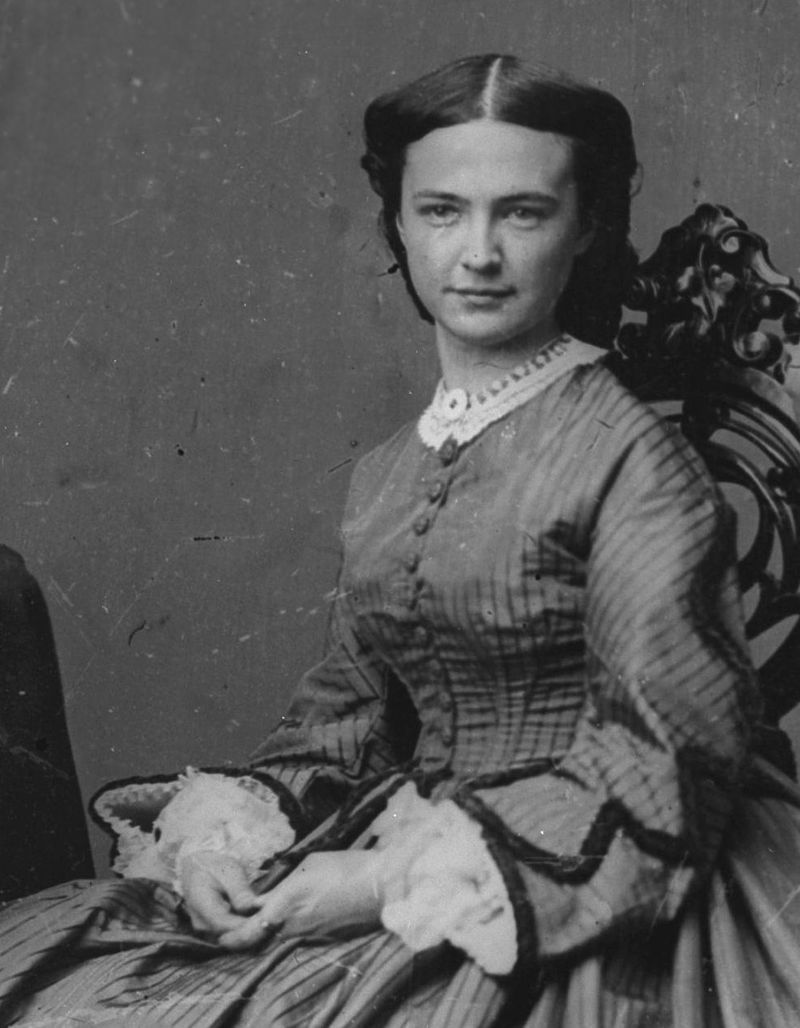
Elizabeth_Bacon_Custer_-_Brady-Handy
Elizabeth “Libbie” Bacon Custer, probably circa 1865

It is largely because of Libbie Custer that her husband’s reputation and his memory in general did not suffer as much, at least for the first century or so after his death.  And frankly, it probably should have suffered.  Custer was brash, egotistical, vain, stubborn, and reckless with the lives of those who he led.  There is a reason he graduated dead last in his West Point class of 1861.  He was a controversial figure while he was alive, much less afterward.  It is largely because of Libby Custer that the view of Custer as a tragic hero perpetuated for so long (see the movie They Died With Their Boots On, with Custer portrayed by Errol Flynn).

But what actually happened at Little Bighorn is much more complex than what was portrayed in popular culture for so long.  And Son of the Morning Star (the book AND the movie) does a much better job than anything before or since in portraying the battle and what happened.  That’s my opinion, for whatever it’s worth.  Here’s a clip of the opening titles and scene, where the column under General Alfred Terry (played by Terry O’Quinn!) arrives on the battlefield to see they have missed the fight.  Note also Captain Frederick Benteen played by David Strathairn.  Also note that the story is largely narrated by the two women.

I don’t know if this film will ever find its way to DVD, much less Blu-Ray, but it should.

~Geoff

Happy Juneteenth, everyone!

Today is the 154th anniversary of the day that slavery ended in the state of Texas, the last part of the Confederacy where slavery had survived.  On June 19th, 1865, Major General Gordon Granger, the commander of the District of Texas for the Union Army, stood on the balcony of Ashton Villa on Galveston Island and read aloud “General Order No. 3” to the crowd that had gathered.  The order began:

The people of Texas are informed that, in accordance with a proclamation from the Executive of the United States, all slaves are free. This involves an absolute equality of personal rights and rights of property between former masters and slaves, and the connection heretofore existing between them becomes that between employer and hired labor.

Ashton_Villa_Galveston_Texas
Ashton Villa, now a restored building on the National Register of Historic Places.

Continue reading “Happy Juneteenth, everyone!”

The Caning of Charles Sumner and the response by Anson Burlingame

I am a bit late to make this a “This Day in History” post, since the actual date in question was May 22nd, 1856.  Still, I wanted to talk about this subject since I have been reading about it and have also recently listened to a rather good podcast about it.  I have only recently begun listening to this Civil War podcast, but I find it quite good so far.  And blogging about history always cheers me up.  Besides, today (May 30th) IS the anniversary of the passage of the Kansas-Nebraska Act of 1854.

Anyway, I have always found the story of the attack on Senator Charles Sumner of Massachusetts by Congressman Preston Brooks of South Carolina to be one of the most shocking incidents leading up to the Civil War.  Only in recent years did I learn the role Massachusetts Congressman Anson Burlingame played in the events that followed.  In my mind, Burlingame is sort of the hero of the story, much more so than Sumner, anyway.

Southern_Chivalry

Continue reading “The Caning of Charles Sumner and the response by Anson Burlingame”

Today in Civil War history – “Remember Ellsworth!”

Today is the 158th anniversary of the death of Colonel Elmer Ellsworth, the first Union officer to die in the Civil War.  His death is also notable because he was a national celebrity and a personal friend of President Abraham Lincoln.

Ellsworth had become famous before the Civil War when he toured the country in the summer of 1860 with his drill team, the National Guard Cadets of Chicago, more famously known as the United States Zouave Cadets.  The unit was famous for its spectacular drill sequences and helped inspire many Zouave units that would appear during the Civil War.

Continue reading “Today in Civil War history – “Remember Ellsworth!””

Brimfield, May 2019 – The Odd, Disturbing, and Weird in Photos

Geoff and I haven’t been able to get to Brimfield for the last 3 years. We’ve both missed it a lot.  But we were able to come this year. Some things have changed (new vendors, more food options, less parking, more 45 supporters) others have stayed the same (bargains if you know where to look, unpredictable weather, good and bad crazy, nice people).

Per usual I documented some of the odder things we encountered. Enjoy.

Continue reading “Brimfield, May 2019 – The Odd, Disturbing, and Weird in Photos”

My Ancestor at the Battle of Spotsylvania

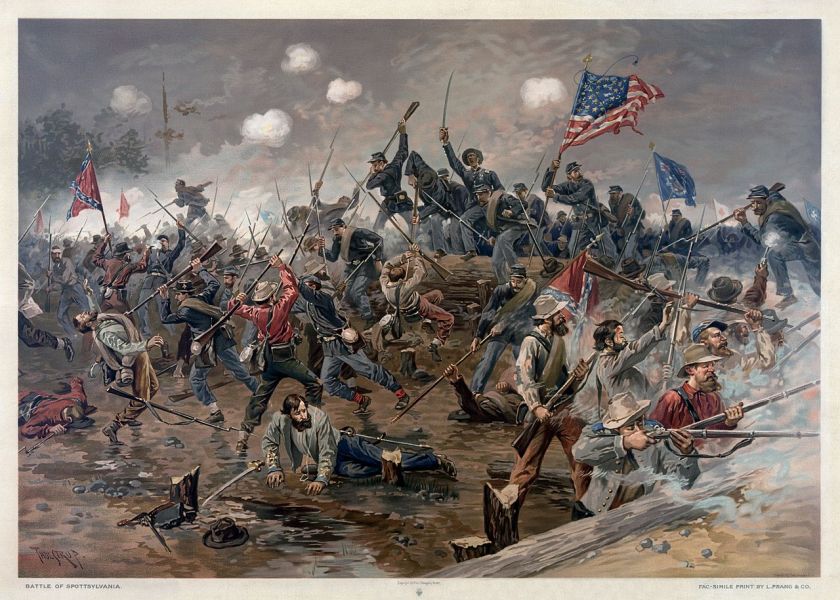
This week is the 155th anniversary of the Battle of Spotsylvania Court House, one of the bloodiest and most terrible battles of the Civil War.  This particular phase of Grant’s Overland Campaign began on May 7th and lasted until May 19th.  The battle is most famous for the Union assaults on a stretch of Confederate fortifications called the Mule Shoe because of its shape, and particularly for the violence that took place in an area known as the Bloody Angle.

1280px-Battle_of_Spottsylvania_by_Thure_de_Thulstrup

Continue reading “My Ancestor at the Battle of Spotsylvania”

A Walk Among the Stones

Today Geoff and I took a trip to South Weymouth, MA to visit Mount Hope Cemetery where his Civil War ancestor, Moses Beaulieu, is buried. Geoff has done a lot of research into Moses Beaulieu and recently discovered a photo of his headstone and rough location in the particular cemetery in South Weymouth.

Continue reading “A Walk Among the Stones”

Some thoughts on Confederate Memorial Day

Today is the anniversary of the death of John Wilkes Booth, the man who murdered President Abraham Lincoln.  And it is also the anniversary of the surrender of the last large Confederate army in the field at Bennett Place, North Carolina.  I assume that for the latter reason (although I have known at least a few people who argued it was for the former), today is also Confederate Memorial Day in Alabama, the state where I was born.

Continue reading “Some thoughts on Confederate Memorial Day”

The “mutiny” in my ancestor’s Civil War regiment

I recently reread a book that I have not read in several years: The Mutiny at Brandy Station: The Last Battle of the Hooker Brigade : a Controversial Army Reorganization, Courts Martial, and the Bloody Days that Followed by Frederick B. Arner.  The book follows through events of early 1864 that led to the dissolution of my ancestor’s former unit, the 3rd Corps, and the assignment of his regiment to the 2nd Corps.  The author makes a compelling argument that one of the major reasons the former 3rd Corps units suffered so severely in the battles of Grant’s Overland Campaign is because the units’ morale had been shattered by the breaking up of the once-proud and distinguished 3rd Corps.

Continue reading “The “mutiny” in my ancestor’s Civil War regiment”

Today in Civil War History: Remembering Fort Pillow

Today is the 155th anniversary of the Battle of Fort Pillow, arguably the most controversial battle of the Civil War, when Confederate forces under Major General Nathan Bedford Forrest attacked the fort on the Mississippi River near Henning, Tennessee. Forrest had at least 1,500 men with him, and the defending Union troops had about 600 or so. The defenders were made up of both former slaves and white Southern Unionists that had enlisted in the Union Army. The fort was captured without too much effort, and then a massacre of the Union troops began.

There are still some who try to argue that there was no massacre, and that accounts of the brutal aftermath of the short siege were exaggerated. No. A thousand times NO. It was indeed a massacre, as some 14 or so Confederates died and some 86 or so were wounded, and the number of Union (and possibly Union civilian) deaths has been estimated to range from at least 220 or so up to 500, with another 130 wounded. We are supposed to believe that the troops defending a fort somehow managed to suffer many more deaths than the attackers? Not to mention that the number of Union deaths are grossly out of proportion with the rest of the casualties? No. And accounts from the Confederates themselves point to the murder of Union soldiers after they surrendered. One Confederate wrote the following in a letter to his family:

Our men were so exasperated by the Yankee’s threats of no quarter that they gave but little. The slaughter was awful. Words cannot describe the scene. The poor deluded negros would run up to our men fall on their knees and with uplifted hands scream for mercy but they were ordered to their feet and then shot down. The whitte [sic] men fared but little better. The fort turned out to be a great slaughter pen. Blood, human blood stood about in pools and brains could have been gathered up in any quantity. I with several others tried to stop the butchery and at one time had partially succeeded but Gen. Forrest ordered them shot down like dogs and the carnage continued. Finally our men became sick of blood and the firing ceased.

Forrest himself admitted that a “wholesale slaughter of the garrison at Fort Pillow” had taken place. He also wrote:

The river was dyed with the blood of the slaughtered for two hundred yards. The approximate loss was upward of five hundred killed, but few of the officers escaping. My loss was about twenty killed. It is hoped that these facts will demonstrate to the Northern people that negro soldiers cannot cope with Southerners.

The story of Fort Pillow also reminds me of one of the great myths of the Civil War that is still being widely passed around as fact. The story goes that the breakdown in the prisoner exchange between North and South was because General Grant did not want to return Confederate prisoners to refill the Southern ranks, and thus his policy led to the overcrowding in prisons North and South that led to so many deaths. Grant, often seen by his critics as being callous in his attitudes toward the lives of his soldiers, is blamed for the policy. Again, that is garbage, an attempt to shift blame for the breakdown to Grant rather than lay it at the feet of those to whom it belongs, i.e. the Confederate authorities.

In the movie Glory, there is a scene that explains what the Confederate Congress did.

Confederate President Jefferson Davis had originally issued a proclamation in late 1862 that basically stated that captured Union black troops (as well as their white officers) would not be treated the same as captured white troops and that they would not be exchanged. The Confederate Congress made Davis’ announcement official policy in May 1863. This was carried out for the first time in July 1863, when Confederates first captured members of the 54th Massachusetts. By the end of that July, President Lincoln formally announced that the previously existing exchange system was no longer valid, and that the exchange system would be halted until the Confederate government agreed to treat captured black soldiers the same as captured white soldiers. They refused, and so the prisoner exchange ended. It would not be resumed until the winter of 1864-1865. By that time, thousands upon thousands of prisoners had died.

~Geoff