The “mutiny” in my ancestor’s Civil War regiment

I recently reread a book that I have not read in several years: The Mutiny at Brandy Station: The Last Battle of the Hooker Brigade : a Controversial Army Reorganization, Courts Martial, and the Bloody Days that Followed by Frederick B. Arner.  The book follows through events of early 1864 that led to the dissolution of my ancestor’s former unit, the 3rd Corps, and the assignment of his regiment to the 2nd Corps.  The author makes a compelling argument that one of the major reasons the former 3rd Corps units suffered so severely in the battles of Grant’s Overland Campaign is because the units’ morale had been shattered by the breaking up of the once-proud and distinguished 3rd Corps.

Continue reading “The “mutiny” in my ancestor’s Civil War regiment”

Today in Civil War History: Remembering Fort Pillow

Today is the 155th anniversary of the Battle of Fort Pillow, arguably the most controversial battle of the Civil War, when Confederate forces under Major General Nathan Bedford Forrest attacked the fort on the Mississippi River near Henning, Tennessee. Forrest had at least 1,500 men with him, and the defending Union troops had about 600 or so. The defenders were made up of both former slaves and white Southern Unionists that had enlisted in the Union Army. The fort was captured without too much effort, and then a massacre of the Union troops began.

There are still some who try to argue that there was no massacre, and that accounts of the brutal aftermath of the short siege were exaggerated. No. A thousand times NO. It was indeed a massacre, as some 14 or so Confederates died and some 86 or so were wounded, and the number of Union (and possibly Union civilian) deaths has been estimated to range from at least 220 or so up to 500, with another 130 wounded. We are supposed to believe that the troops defending a fort somehow managed to suffer many more deaths than the attackers? Not to mention that the number of Union deaths are grossly out of proportion with the rest of the casualties? No. And accounts from the Confederates themselves point to the murder of Union soldiers after they surrendered. One Confederate wrote the following in a letter to his family:

Our men were so exasperated by the Yankee’s threats of no quarter that they gave but little. The slaughter was awful. Words cannot describe the scene. The poor deluded negros would run up to our men fall on their knees and with uplifted hands scream for mercy but they were ordered to their feet and then shot down. The whitte [sic] men fared but little better. The fort turned out to be a great slaughter pen. Blood, human blood stood about in pools and brains could have been gathered up in any quantity. I with several others tried to stop the butchery and at one time had partially succeeded but Gen. Forrest ordered them shot down like dogs and the carnage continued. Finally our men became sick of blood and the firing ceased.

Forrest himself admitted that a “wholesale slaughter of the garrison at Fort Pillow” had taken place. He also wrote:

The river was dyed with the blood of the slaughtered for two hundred yards. The approximate loss was upward of five hundred killed, but few of the officers escaping. My loss was about twenty killed. It is hoped that these facts will demonstrate to the Northern people that negro soldiers cannot cope with Southerners.

The story of Fort Pillow also reminds me of one of the great myths of the Civil War that is still being widely passed around as fact. The story goes that the breakdown in the prisoner exchange between North and South was because General Grant did not want to return Confederate prisoners to refill the Southern ranks, and thus his policy led to the overcrowding in prisons North and South that led to so many deaths. Grant, often seen by his critics as being callous in his attitudes toward the lives of his soldiers, is blamed for the policy. Again, that is garbage, an attempt to shift blame for the breakdown to Grant rather than lay it at the feet of those to whom it belongs, i.e. the Confederate authorities.

In the movie Glory, there is a scene that explains what the Confederate Congress did.

Confederate President Jefferson Davis had originally issued a proclamation in late 1862 that basically stated that captured Union black troops (as well as their white officers) would not be treated the same as captured white troops and that they would not be exchanged. The Confederate Congress made Davis’ announcement official policy in May 1863. This was carried out for the first time in July 1863, when Confederates first captured members of the 54th Massachusetts. By the end of that July, President Lincoln formally announced that the previously existing exchange system was no longer valid, and that the exchange system would be halted until the Confederate government agreed to treat captured black soldiers the same as captured white soldiers. They refused, and so the prisoner exchange ended. It would not be resumed until the winter of 1864-1865. By that time, thousands upon thousands of prisoners had died.

~Geoff

Today in history, the last great battle before Appomattox

It’s funny that I have been a pretty serious student of the Civil War for almost 30 years, and yet I am still learning and discovering so many things that I really did not know much about. Lately a lot of that has been due at least partially to Private Moses Beaulieu. I have been trying to follow his (my Civil War ancestor’s) journey through the war. Most recently, I have been studying the last great campaigns of the war for his unit, the 11th Massachusetts Infantry, in the Army of the Potomac.

Continue reading “Today in history, the last great battle before Appomattox”

This Day in History: the Battle of Mill Springs

Today, January 19th, is the 157th anniversary of the Battle of Mill Springs, fought between Union and Confederate forces in south-central Kentucky in 1862. It was the first important Federal victory of the war after the terrible defeat at the (First) Battle of Bull Run the previous July.

Continue reading “This Day in History: the Battle of Mill Springs”

Some Predictions for GoT Season 8

Well, here we are – rapidly approaching the final season of my favorite TV show.  HBO has released some teasers and such.

So I thought I might make some predictions for what we might see in the final season of the show, and specifically, who I think will live and who will die.

Continue reading “Some Predictions for GoT Season 8”

Winter is coming, finally

I love New England.  One of the things I love most about it is that is has four distinct seasons (five, if you count Mud Season).  So when the winter weather here starts acting like the winter weather in the South, i.e. rainy and cool with no snow, it kind of annoys me a bit.  I expect to have snow.  And we have had no snow (or bitter cold) since November.  We had a wet fall, and that seems to have extended into winter.

Well, it now looks like we will get our first winter storm of the season, some six weeks into calendar winter.  And for some of New England, it looks like it may be a real doozy.

Continue reading “Winter is coming, finally”

My Time as a VIP and the National Park Service

Today is the anniversary of the Battle of Stones River.  I could do a long post about what happened on this day in 1863 but instead I want to talk about my own personal experience with the National Park Service, which is currently suffering from the government shutdown, and how that shutdown affects the NPS.

For over a decade I was a member of the Volunteers-in-Parks program for the National Park Service and really enjoyed it.  I spent most of my time at the Stones River National Battlefield in Murfreesboro, Tennessee, although I also spent some time at other nearby parks, especially Fort Donelson National Battlefield and Chickamauga & Chattanooga National Military Park.

When I first joined the National Park Service as a volunteer, it was so I could join the living history program at Stones River.  My first year I probably put in something like 150 to 200 hours of volunteer work, and afterward I was probably regularly doing at least 75 to 100 hours a year.  Even after I moved back to Huntsville and lived 2 hours away, I still managed to put in some hours for the NPS.  Why did I do this?  Because it was wonderful.  In fact, I view my time with the NPS as one of the most positive experiences I have ever had.  The people were just great, and I truly enjoyed interacting with visitors and the public in general.  Although I had done some public speaking before, I really developed that skill with the NPS.  It also gave me the chance to interact with some great historians, like Ed Bearss.

But right now, the NPS suffers from being massively understaffed.  The Trump administration apparently thought they could alleviate some of the effects of the shutdown on the National Parks by allowing them to be open during the shutdown, as opposed to closing them like the government did back in 2013.  It sounds great, at least on paper.  But allowing the public to continue to use the parks even though most park service employees are absent means that no one is cleaning the bathrooms, or handing out maps, or emptying the garbage cans.  It also means no one is collecting admission fees or enforcing rules.  And so the amount of wear and tear that is taking place is pretty bad.  And so many sites are being forced to close their doors.  A recent article from a Nashville TV station showed that many of the Civil War sites where I had volunteered are being affected by the shutdown.

So I hope that the shutdown does not last too long, as I hate to see so many of these parks get wrecked with no one to do any cleaning up.  And maybe one day I will be able to do some history volunteering again.  We’ll see.

~Geoff

A Visit to Winthrop by Saint Nicholas

T’was the night before Christmas and all through the house,
Not a creature was stirring, especially not a mouse.
The children were snoring all snug in our bed,
And I killed time as sermon number two was said.
Geoff read his history book in the loft,
After the last high notes of the night, I coughed.
We stumbled on home as the clock struck three,
And were greeted by Dash who needed to pee.

After feeding each dog and both of the cats,
We took off our coats, shoes, and hats.
With dawn fast approaching we took to our bed,
With visions of sleeping late stuck in our heads.

When in the back yard there arose such a clatter,
Dash sprang from the bed to see what was the matter.
A dachshund stampede that was gone in a flash,
I groaned, shook my head, and then muttered “DASH!”

The moon couldn’t shine off of non-existent snow
(No White Christmas for us this year as you know),
When, what to my wondering eyes should appear,
But a flying sleigh, and nine panting reindeer.

My first thought was that I must be sick,
“There’s no way that I could be seeing St. Nick!”
More rapid than eagles his nine reindeer came,
And he whistled, and shouted, and called them by name;

“Now, DASHER! now, DANCER! now, PRANCER and VIXEN!
On, COMET! on CUPID! on, DONNER and BLITZEN!
And RUDOLPH!  Keep that nose of yours shining with light!
There’ll be no mid-air sleigh collisions tonight!”

As a ball when it meets Teddy Ballgame would fly,
The reindeer and sleigh fiercely arced through the sky,
And up to the house-top the reindeer they flew,
And suddenly I wondered what Santa would do.

And then, in a twinkling, I heard on the roof
The pounding and scratching of each reindeer hoof.
I wondered whether Santa had already found,
That we have no chimney! And two small loud hounds!

I blinked to be sure of what I was seeing
When I realized that, yep, Rudolph was peeing.
Santa hopped out of the sleigh and dusted his clothes,
He strode across the yard like someone who knows.

He was dressed all in fur, from his head to his foot,
And his clothes were all dirty with ashes and soot;
A bundle of toys he had crammed in a sack,
He looked like Mall Santa, coffee break over, heading back.

His eyes — how they twinkled! his dimples how merry!
His cheeks were like roses, his nose like a cherry!
He laughed as he kicked off melting ice and slush,
“Good God,” I said, “Santa Claus is a lush.”

The stump of a pipe he held tight in his teeth,
And the smoke it encircled his head like a wreath;
So naturally we started to hear a loud screech.
“The smoke alarm! Where’s the stepladder to reach?”

He was chubby and plump, a right jolly old elf,
Not anything like that creepy one on the shelf;
Then I saw he had another bag, packed full of coal,
And I wondered where he’d found it at the North Pole.

He saw the look on my face, and he smiled as he said
“Don’t worry, there’s no reason for you to feel dread.
That coal’s for the White House, they’ve all been quite bad,
Ivanka, Jr., Eric, and ESPECIALLY their dad!”

“But Santa,” I said, “do you have anything more?
Robert Mueller works very hard on this terrible chore.”
He chuckled and said in his cheery slurred speech,
“Fear not, they’ve got all that they need to impeach!”

He sprang to his sleigh, to his team gave a whistle,
They flew low and away, to avoid any missiles.
But I heard him exclaim, ere he drove out of sight,
“HAPPY CHRISTMAS TO ALL*, AND TO ALL A GOOD-NIGHT!”
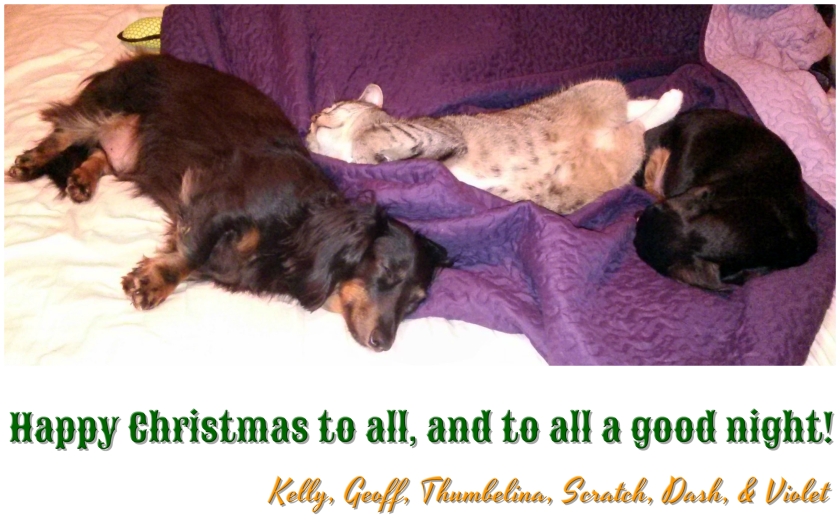
*Except certain people in DC.

On not giving a damn

Disclaimer: Geoff loathes this movie and book upon which it is based.  That’s not why I am posting it here.  That’s just a bonus.  (Love you, sweetie.)

The scene above is important for one really major reason.  For all of their ups and downs and crazy drama, Rhett no longer cares for Scarlett.  At all.  He doesn’t love her, he doesn’t hate her, he just doesn’t care.

This is probably where I should warn you that this post is about unpleasant things.  Trauma, PTSD, abuse – a lot of stuff.  Turn back here should you need to.  Likewise, for a variety of reasons, what I’m going to write may be a bit opaque with oblique references.  This is necessary.  I apologize for the confusion.

Continue reading “On not giving a damn”